If you want to keep reading this, I’m going to need you to type something on your keyboard every two minutes.
Can you imagine? You’d close the tab. You’d go somewhere else. You’d tell someone about it.
That’s the experience I had last night trying to activate a new phone through a major telecommunications company — one I actually worked for, about six years ago, when we were identifying these exact kinds of problems and trying to fix them.
I typed my issue into the chat assistant. It responded with a workflow of pre-set options, none of which matched my situation. I clicked through five or six of them before typing “agent.” It asked me three more questions. Then it connected me to a human.
The first thing the human said, after the greeting, was that I needed to type a message every two minutes to keep the session alive.
Not them. Me. The customer who already has a problem. I have to do work to stay connected to the person trying to help me.
That’s not an AI problem. It’s not even a problem AI can solve. It’s a product decision that someone made, or a technical limitation that someone accepted, and it’s been sitting there making customers feel like a burden since before I worked there.
The Mute Button That Wasn’t
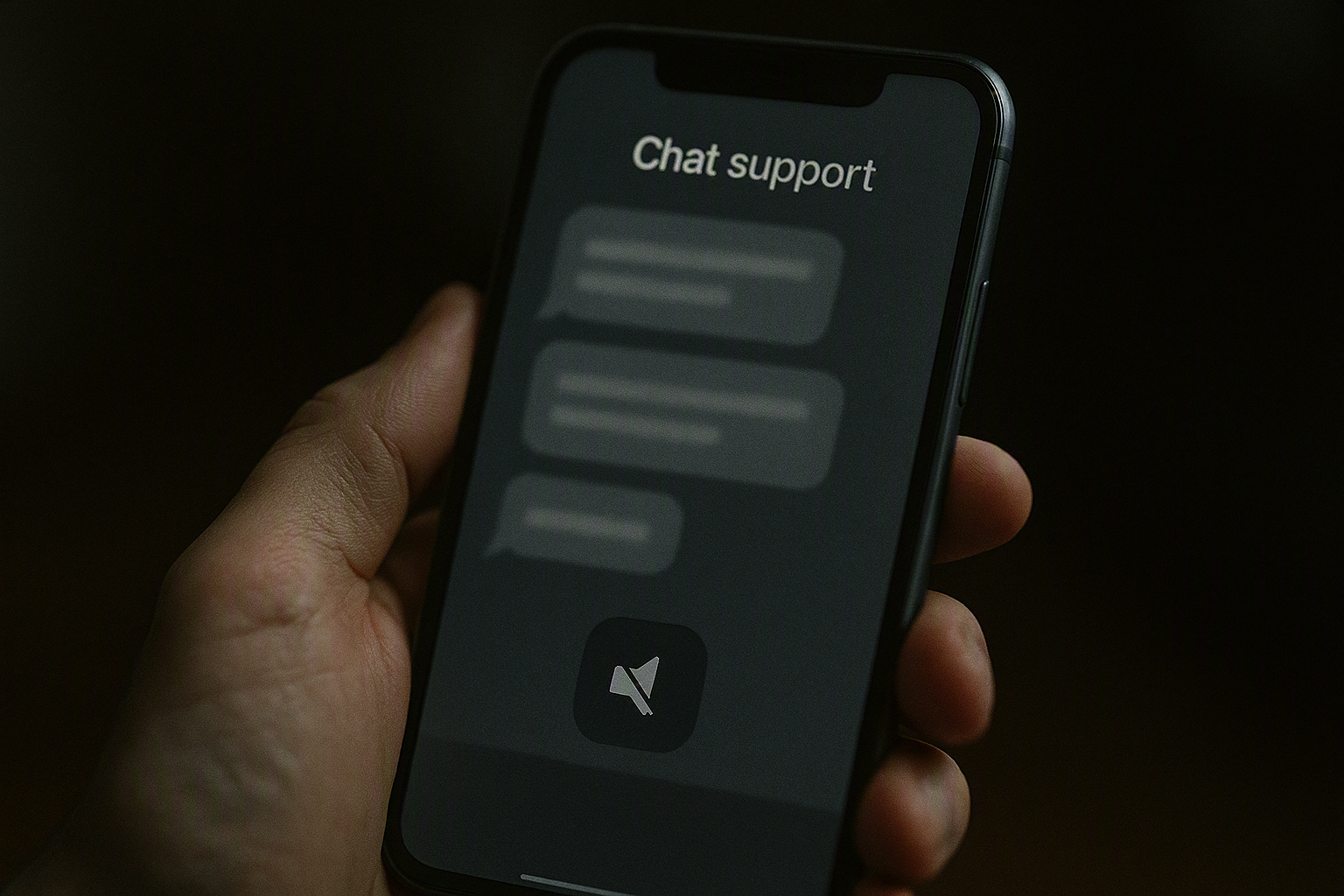
While I waited, I started my audiobook on the same phone I was using for the chat. Every time a message came in from the agent, a notification sound interrupted the audio.
I noticed a mute icon at the top of the chat. I tapped it. The icon changed to show it was muted. I restarted the audiobook.
The next message came in. The sound played. The audiobook stopped.
The mute button didn’t mute anything. It changed its icon. Those are not the same thing.
This is a product problem. A design problem. Someone built a feature, shipped it, and either never tested it in a real use scenario or tested it and accepted the gap between what it looked like and what it did. A customer using a phone to listen to something while they wait on a chat is not an edge case. That’s Tuesday.
These are the kinds of things you find when you walk through your own product as a customer. Not in a lab. Not with a test account. As a customer, with a real problem, in a real context, trying to get something done.
An Hour Later
After about an hour of troubleshooting, the agent, who was genuinely helpful and clearly trying, told me there was a process that needed to run on the back end. They’d put in a ticket. It would be resolved, but not tonight.
Which meant I’d be without a phone until it was.
I asked what I should do if there was an emergency. They offered a workaround: set up a new line, activate the phone on that, switch back later. Creative. But if the activation experience was this complicated, kicking it down the road felt like borrowing trouble. I declined and started wrapping up the chat.
Then the agent, almost certainly prompted by their system, offered to tell me about current internet plan upgrades.
I want to be precise about what happened there. My problem wasn’t solved. I was going to be without a phone overnight. The chat had taken an hour. And the system fired an upsell.
That’s not a bug. Someone designed that. Someone looked at the data on upsell conversion and decided the trigger should fire regardless of whether the customer’s issue was resolved. The metric the team is measured on includes upsell attempts. So the system attempts the upsell. The customer experience is not the metric.
What AI Has to Do With Any of This
None of these problems are AI problems. The session timeout, the mute button, the upsell timing — none of them require a language model to fix. They require someone to walk through the product as a customer, identify what’s broken, and have the organizational support to fix it.
Six years ago, when I worked there, we were calling out problems like these. Some got fixed. Some didn’t. The ones that didn’t weren’t technically hard. They were prioritization decisions. There was always something more exciting to work on, something more fundable, something that showed better in a demo. Now that something is AI.
I work in AI. I know what the technology can do and I believe in it. But companies are investing heavily in making their customer service smarter while the foundational product and design problems that have existed for years go unfixed. The AI layer gets better. The experience layer stays broken. The customer lives in the experience layer.
Here’s the question worth asking before the next AI investment: if you asked your customers what frustrated them most about your product, would any of them say it doesn’t have enough AI?
Probably not.
They’d say the mute button doesn’t work. They’d say they had to type every two minutes to keep the session alive. They’d say someone tried to sell them an internet upgrade after failing to activate their phone.
Those are fixable. They were fixable six years ago. They’re still broken.
Not because the technology doesn’t exist to fix them. Because the attention is somewhere else.
I’m still thinking about the mute button.