
David Monnerat

Product + AI | Systems Thinker | Enterprise Reality

Tag: generative AI

  • RAG Against the Machine

    RAG Against the Machine

    Who controls the past now controls the future
    Who controls the present now controls the past.


    Rage Against the Machine, “Testify”

    There is irony in starting this post with a Rage Against the Machine (RATM) quote. They’re not just a band known for relentless protest against oppression, corporate greed, police brutality, war, propaganda, and systemic injustice; they’re a call to action, urging listeners to question authority, challenge the status quo, and fight for change.

    Quoting RATM in a post aimed at helping corporations use AI more effectively would draw the ire of Zack de la Rocha. However, my motivation is to question the blind adoption of a technology without doing the hard work that would improve outcomes for the people, in this case, the users and customers.

    The Status Quo

    In my career, I’ve spent a lot of time focused on improving the customer experience, whether working on self-service tools like chatbots or finding ways to help internal employees better serve customers. In both cases, the goal is to provide the right answer at the right time to help customers get the most out of our products and services.

    A common challenge in customer service, especially in call centers, is finding the answer to satisfy a customer’s need. Often, companies have large collections of documents managed by a content management system (CMS). Different yet overlapping documents may exist across products or business lines or intended for different audiences, such as internal or customer-facing documentation. Errors and updates may inconsistently cascade throughout the documentation, resulting in missing, incorrect, or conflicting information. As a result, the CMS may return the wrong results, causing slower response times, conflicting answers, higher call volumes, and frustration by both employees and customers.

    The RAG

    With the availability of large language models (LLMs) and the introduction of retrieval-augmented generation (RAG), organizations saw a possible solution to improve the search process. RAG offered a way to retrieve a specific answer to a question, rather than returning a document in a search result that would need to be read to find the answer. It was also seen as a way to overcome the challenges of poor documentation.

    Companies quickly discovered, however, that this wasn’t the case. Whether it was due to missing, incorrect, or conflicting information1,2, the adage of “garbage in, garbage out” applied and resulted in poor performance.

    Additionally, the documentation format made it difficult to ingest and maintain the complete context, even if the documentation itself was correct. Key information in images, tables, and complex formatting is often lost or misinterpreted in a RAG system.3

    Ultimately, these challenges caused these systems to be delayed or prevented them from being deployed at scale.

    The Machine

    The “machine” represents the continuation of the status quo. In this case, it symbolizes the tendency to think every problem can be solved with the latest technology. It involves our inclination to blindly trust often-overhyped technology to solve problems without fixing any underlying issues. It also includes grinding through poor implementations and subpar results rather than dedicating resources to evaluating other less-hyped or less-technical solutions.

    I’ve worked on AI products where the underlying data was so bad that it was impossible to make reliable, actionable predictions. But rather than direct teams to fix the underlying data, the machine allows for only one direction–forward. The only acceptable actions were to continue to endlessly iterate and hope for a different result, to lower the bar for success, or look for a problem that we could solve with the bad data, even if it doesn’t align with the original or important business goals.

    It’s happening again with RAG and generative AI. The machine is seeking technical tweaks to improve the results rather than fixing the underlying documentation or converting it to a more RAG-friendly format. Change the chunking strategy. Fix the embeddings. Adjust the prompt. Select a different algorithm. Use reinforcement learning with human feedback. 4,5,6

    Of course, these are great recommendations when the underlying problem isn’t the data or the documentation. But they’re ineffective when the problem is the source. No amount of tweaking will fix fundamentally bad documentation.

    The Resistance

    If the machine perpetuates the existing pattern, the resistance challenges that pattern, takes a different approach, and focuses on the business goal, not the technology.

    At its core, RAG is designed to make searching better. It includes additional benefits such as synthesizing coherent, context-aware responses, but in service of returning the most relevant, useable answers to a user.

    To take advantage of RAG’s secondary benefits, companies should not rush into the technical solution pushed by the machine and instead spend time fixing the documentation. As controversial as that recommendation seems, it’s the most fundamental task likely to improve search results.

    In a world where generative AI initiatives benefit from seemingly unlimited funding, requesting resources to update documentation will likely draw questions.

    Why can’t we solve this with technology? Have you heard about this new feature that might solve the issue? Can we bring in a new vendor?

    It is up to leaders to take a stand and convince the business to take a different path. It requires focusing on the business problem, identifying the root cause, and recommending the best way to address it.

    If the root cause of poor search results is the documentation, addressing issues in the documentation is the best course of action and may show immediate improvements with the existing search solution. It’s possible the improvements will be dramatic enough to not require RAG at all, at least right away. But it leaves the door open to implement a RAG-based solution on top of better documentation to take advantage of RAG’s additional benefits.

    The machine will persist.

    But leaders must resist.

    Conclusion

    The allure of new technology is powerful. The promise of AI and RAG as instant solutions to deeply rooted problems is tempting, especially in corporate environments eager for innovation. But when the fundamental issue is bad documentation, no AI model—no matter how sophisticated—can fully compensate for it.

    The real battle isn’t against the technology itself but against the mindset that technology alone is always the answer. True leadership means recognizing when the most effective solution isn’t the most exciting or trendy one, but the one that addresses the root cause.

    Fixing documentation isn’t glamorous. It won’t make headlines like an AI-powered chatbot or a multimillion-dollar LLM investment. But it’s the foundation of good search, good RAG, and ultimately, good customer experience. Without it, RAG becomes just another iteration of the machine—grinding forward without progress.

    So before blindly deploying the latest AI tool, ask this question: Are we solving the problem, or are we just feeding the machine?

    1. https://www.valprovia.com/en/blog/top-7-challenges-with-retrieval-augmented-generation
      ↩︎
    2. https://www.aimon.ai/posts/top_problems_with_rag_systems_and_ways_to_mitigate_them
      ↩︎
    3. https://arxiv.org/abs/2401.05856
      ↩︎
    4. https://snorkel.ai/blog/retrieval-augmented-generation-rag-failure-modes-and-how-to-fix-them/
      ↩︎
    5. https://medium.com/towards-data-science/12-rag-pain-points-and-proposed-solutions-43709939a28c
      ↩︎
    6. https://doi.org/10.48550/arXiv.2501.13264
      ↩︎
  • The White Whale

    The White Whale

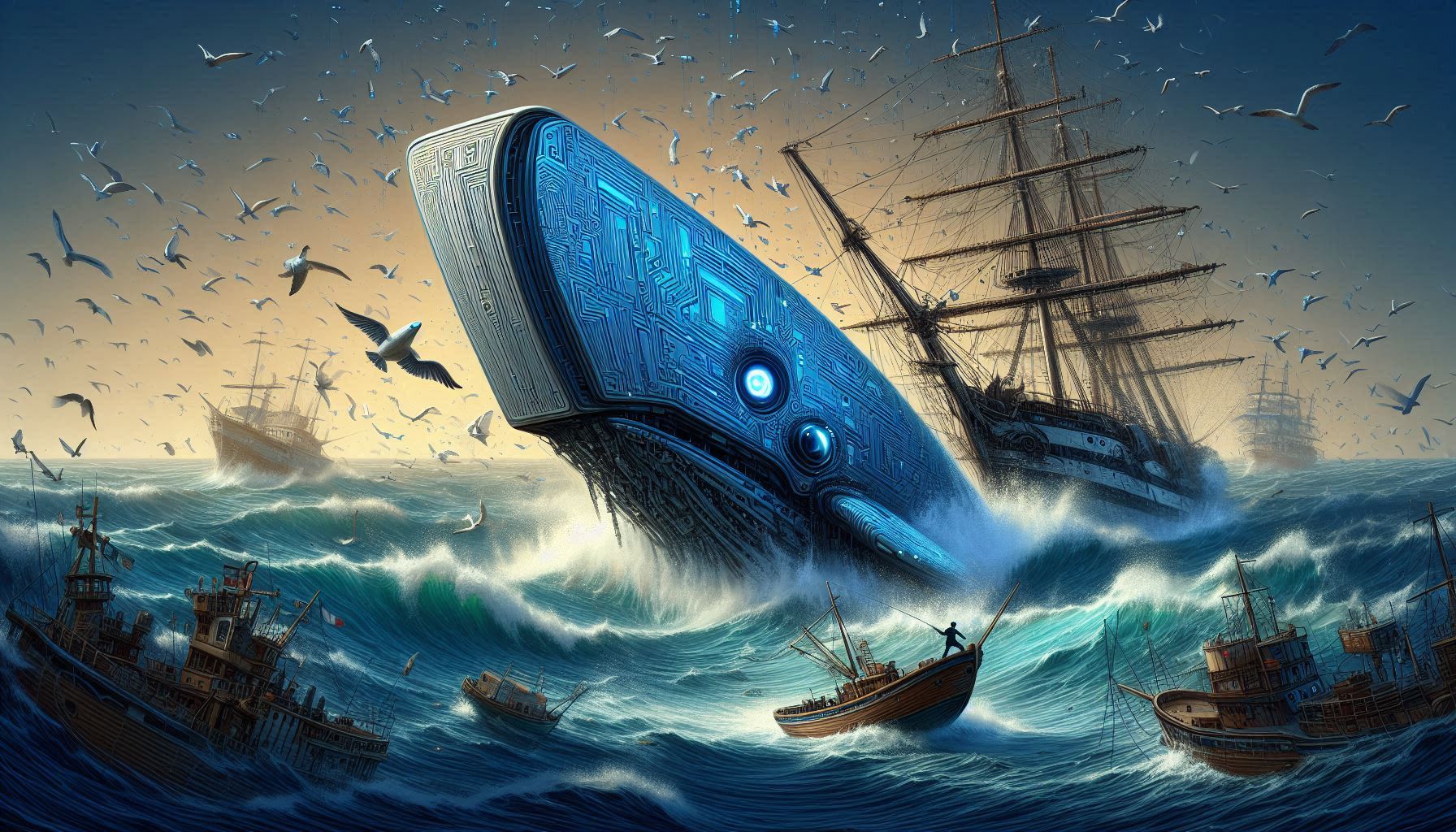
    In Moby-Dick, Captain Ahab’s relentless pursuit of the white whale isn’t just a quest for revenge; it’s a cautionary tale about obsession. Ahab becomes so consumed by his singular goal that he ignores the needs of his crew, the dangers of the voyage, and the possibility that his mission might be misguided.

    This mirrors a common trap in problem-solving: becoming so fixated on a single solution—or even the idea of being the one to solve a problem—that we lose sight of the bigger picture. Instead of starting with a problem and exploring the best ways to address it, we often cling to a solution we’re attached to, even if it’s not the right fit or takes us away from solving the actual problem.

    A Cautionary Tale

    Call me Ishmael.1 – Herman Melville

    I once worked on a project to identify potential customer issues. The business provided the context and success metrics, and we were part of the team set out to solve the problem.

    After we started, an executive on the project who knew the domain had a specific vision for how the solution should work and directed us on exactly what approach to use and how to implement it. While their approach seemed logical to them, it disregarded key best practices and alternative solutions that could have been more effective.

    We ran experiments to test both the executive’s approach and an alternative, using data to demonstrate how a different approach produced better results and would improve business outcomes.

    But the executive was undeterred. They shifted resources and dedicated teams to their solution, intent on making it work. We continued a separate effort in parallel but without the resources or backing of the received by the other team.

    The Crew

    Like the crew of the Pequod, the teams working on the executive’s solution were initially excited about the attention and resources. They came up with branding and a concept that made for good presentations. The initial few months were spent creating an architecture and building data pipelines under the presumption that the solution would work. Each update gave a sense of progress and success as items were crossed off the checklist.

    That success, though, was based on output, not outcomes. Along the way, the business results weren’t there, and team members began to question the approach. However, even with these questions and the evidence that our approach was improving business outcomes, the hierarchical nature of the commands kept the crew from changing course.

    The Prophet

    In Moby Dick, Captain Ahab smuggles Fedallah, an almost supernatural harpooner, onto the ship as part of a hidden crew. Fedallah is a mysterious figure who serves as Ahab’s personal prophet, foretelling Ahab’s fate.

    Looking for a prophet of their own, our executive brought in a consulting firm to see if they could get the project on track. The firm’s recommendations largely mirrored those of our team. However, similar to Fedallah’s prophecies, the recommendations were misinterpreted. What we saw as clear signals to change course, the executive saw as a chance of success and doubled down on their solution.

    The Alternate Mission

    Near the end of the novel, the captain of another vessel, the Rachel, pleads with Ahab to help him find his missing son, lost at sea. Ahab refuses because he is too consumed by his revenge. Ultimately, the obsession costs Ahab his life as well as those of his crew, with the exception of Ishmael, who was, ironically, rescued by the Rachel, the whaling ship that had earlier begged Ahab for help.

    We tried to bridge the gap between the two efforts for years, but the executive’s fixation on their solution made collaboration impossible. We made a strong case using data to change the mission from making their solution work to refocusing on the business goals and outcomes. Unfortunately, after many attempts, we weren’t able to convince them or affect their bias and feelings that their solution should work. Too many claims had already been made, and too much had been invested to change course. The success of their solution was the only acceptable end of the journey, with that success always being just over the horizon.

    A Generative White Whale

    I’ve been thinking about this story lately because I see the same pattern happening with generative AI. Just as Captain Ahab chases Moby Dick, many companies chase technological solutions without fully understanding if those solutions will solve their real business problems.

    Since ChatGPT was launched to the public in 2022, there has been pressure across industries to deliver on generative AI use cases. The impressive speed at which users signed up and the ease at which ChatGPT could respond to questions gave the appearance of an easy implementation path.

    Globally, roadmaps were blown up and rebuilt with generative AI initiatives. Traditional intent classification and dialog flows were replaced with large language models in conversational AI and customer support projects. Retrieval-augmented generation changed search and summarization use cases.

    Then, the world tried to use it. Everyone quickly learned that the models didn’t work out of the box and underestimated the amount of human oversight and iteration needed to get reliable, trustworthy results.2 We learned that their data wasn’t ready to be consumed by these models and underestimated the effort required to clean, label, and structure the data for generative AI use cases. We learned about hallucinations, toxic and dangerous language in responses, and the need for guardrails.

    But the ship had sailed. The course had been set. Roadmaps represent unchangeable commitments3. The mission to hunt for generative AI success continued.

    What started with use cases with clear business outcomes inherited from the pre-generative AI days started to change. Rather than targeting problems that could significantly impact business goals, the focus shifted to finding problems that could be solved with generative AI. Companies had already invested too much time, money, and opportunity cost, and they needed to deliver something of value to justify the voyage.4,5

    It became an obsession.

    A white whale.

    Chasing the Right Whale

    I try all things, I achieve what I can.6 – Herman Melville

    That’s not to say there isn’t a place for generative AI or other technology as possible solutions. I’ve been working with AI for almost a decade and have seen how it can be truly powerful and transformative when applied to the right use case that aligns with business outcomes and solving customer or business problems.

    Experimenting with the technology can foster innovation and uncover new opportunities. However, when the organization shifts focus away from solving its most critical business problems and towards delivering a solution or leveraging a specific technology for the sake of the solution or the technology, misalignment between those two paths and choosing the wrong goal can put the entire mission at risk. The mission should always be the success of the business, not the technology.

    That’s the difference between chasing the white whale and chasing the right whale.

    Assess Your Mission

    The longer a project goes on, the more likely it will veer off course. Little choices over time make small adjustments to direction that can eventually lead to being far away from the intended destination. The same thing can happen with the overall mission. Ahab started his journey hunting whales for resources and, while he was still technically hunting a whale, his mission changed to revenge. If he took the time to reassess his position and motivation, Moby Dick would have had a less dramatic ending.

    As product and delivery teams, it’s healthy practice to occasionally look up and evaluate the current position and trajectory. While there may be an argument for intuition in the beginning, as more information becomes available, it’s important to leverage data and critical thinking rather than intuition and feelings which are more prone to bias.

    These steps can help guide that process.

    1. Reaffirm Business and Customer Priorities.

    Align leadership around the most critical problems. Start by revisiting the company’s core objectives and defining success. Then, identify the biggest challenges facing the business and customers before considering solutions.

    2. Audit and Categorize Existing Projects

    Identify low-impact or misaligned projects. List all ongoing and planned AI initiatives, categorizing them based on:

    • Business impact (Does it solve a top-priority problem?)
    • Customer impact (Does it improve user experience or outcomes?)
    • Strategic alignment (Is it aligned with company goals, or is it just chasing trends?)

    An important factor here is articulating and measuring how the initiative impacts business and customer goals rather than relates to a business or customer goal.

    For example, a common chatbot goal is to reduce support costs (business goal) by answering customer questions (customer goal) without the need to interact with a support agent. A project that uses generative AI to create more natural responses might look like it’s addressing a need, but it assumes that a more conversational style will increase adoption or improve outcomes. However, making responses more conversational doesn’t necessarily make them more helpful. If the chatbot still struggles with accurate issue resolution, customers will escalate to an agent anyway.

    3. Assess Generative AI’s Fit

    Ensure generative AI is a means to an end, not the goal itself.

    Paraphrasing one of my mantras I would use when a team approached me with an “AI problem” to solve:

    There are no (generative) AI problems. There are business and customer problems for which (generative) AI may be a possible solution.

    For each project, ask: Would this problem still be worth solving without generative AI?

    If a generative AI project has a low impact, determine if there’s a higher-priority problem where AI (or another solution) could create more value.

    4. Adjust the Roadmap with a Zero-Based Approach

    Rather than tweaking the existing roadmap, start from scratch by prioritizing projects based on impact, urgency, and feasibility.

    Reallocate resources from lower-value AI projects to initiatives that directly improve business and customer outcomes.

    5. Set Success Metrics and Kill Switches

    Define clear, measurable success criteria for every project. Establish a review cadence (e.g., every quarter) to assess whether projects deliver value. If a project fails to meet impact goals, have a predefined exit strategy to stop work and shift resources.

    This structured approach ensures that AI projects are evaluated critically, business needs drive technology decisions, and resources are focused on solving the most important problems—not just following trends.

    Conclusion

    The lesson of Moby-Dick is not just about obsession—it’s about losing sight of the true mission. Ahab’s relentless pursuit led to destruction because he refused to reassess his course, acknowledge new information, or accept that his goal was misguided. In business and technology, the same risk exists when companies prioritize solutions over problems and fixate on a specific technology rather than its actual impact.

    Generative AI holds incredible potential, but only when applied intentionally and strategically. The key is to stay grounded in business priorities, customer needs, and measurable outcomes—not just the pursuit of AI for AI’s sake. By regularly evaluating projects, questioning assumptions, and ensuring alignment with meaningful goals, teams can avoid chasing white whales and steer toward solutions that drive success.

    The difference between success and failure isn’t whether we chase a whale—it’s whether we’re chasing the right one.

    And I only am escaped alone to tell thee.7 – Herman Melville

    1. “Call me Ishmael.” This is one of the most famous opening lines in literature. It sets the tone for Ishmael’s role as the narrator and frames the novel as a personal account rather than just an epic sea tale. ↩︎
    2. https://www.cio.com/article/3608157/top-8-failings-in-delivering-value-with-generative-ai-and-how-to-overcome-them.html ↩︎
    3. Roadmaps are meant to be flexible and adjusted as priorities and opportunities change. ↩︎
    4. https://www.journalofaccountancy.com/issues/2025/feb/generative-ais-toughest-question-whats-it-worth.html ↩︎
    5. https://www.gartner.com/en/newsroom/press-releases/2024-07-29-gartner-predicts-30-percent-of-generative-ai-projects-will-be-abandoned-after-proof-of-concept-by-end-of-2025 ↩︎
    6. This quote from Ishmael reflects a spirit of perseverance and pragmatism, emphasizing the importance of effort and adaptability in the face of challenges. ↩︎
    7. The closing line of the novel echoes the biblical story of Job, in which a lone survivor brings news of disaster, underscoring the novel’s themes of fate, obsession, and destruction. ↩︎