David Monnerat

Product + AI | Systems Thinker | Enterprise Reality

Category: technology

  • If You Want to Keep Reading This Post

    If You Want to Keep Reading This Post

    If you want to keep reading this, I’m going to need you to type something on your keyboard every two minutes.

    Can you imagine? You’d close the tab. You’d go somewhere else. You’d tell someone about it.

    That’s the experience I had last night trying to activate a new phone through a major telecommunications company — one I actually worked for, about six years ago, when we were identifying these exact kinds of problems and trying to fix them.

    I typed my issue into the chat assistant. It responded with a workflow of pre-set options, none of which matched my situation. I clicked through five or six of them before typing “agent.” It asked me three more questions. Then it connected me to a human.

    The first thing the human said, after the greeting, was that I needed to type a message every two minutes to keep the session alive.

    Not them. Me. The customer who already has a problem. I have to do work to stay connected to the person trying to help me.

    That’s not an AI problem. It’s not even a problem AI can solve. It’s a product decision that someone made, or a technical limitation that someone accepted, and it’s been sitting there making customers feel like a burden since before I worked there.


    The Mute Button That Wasn’t

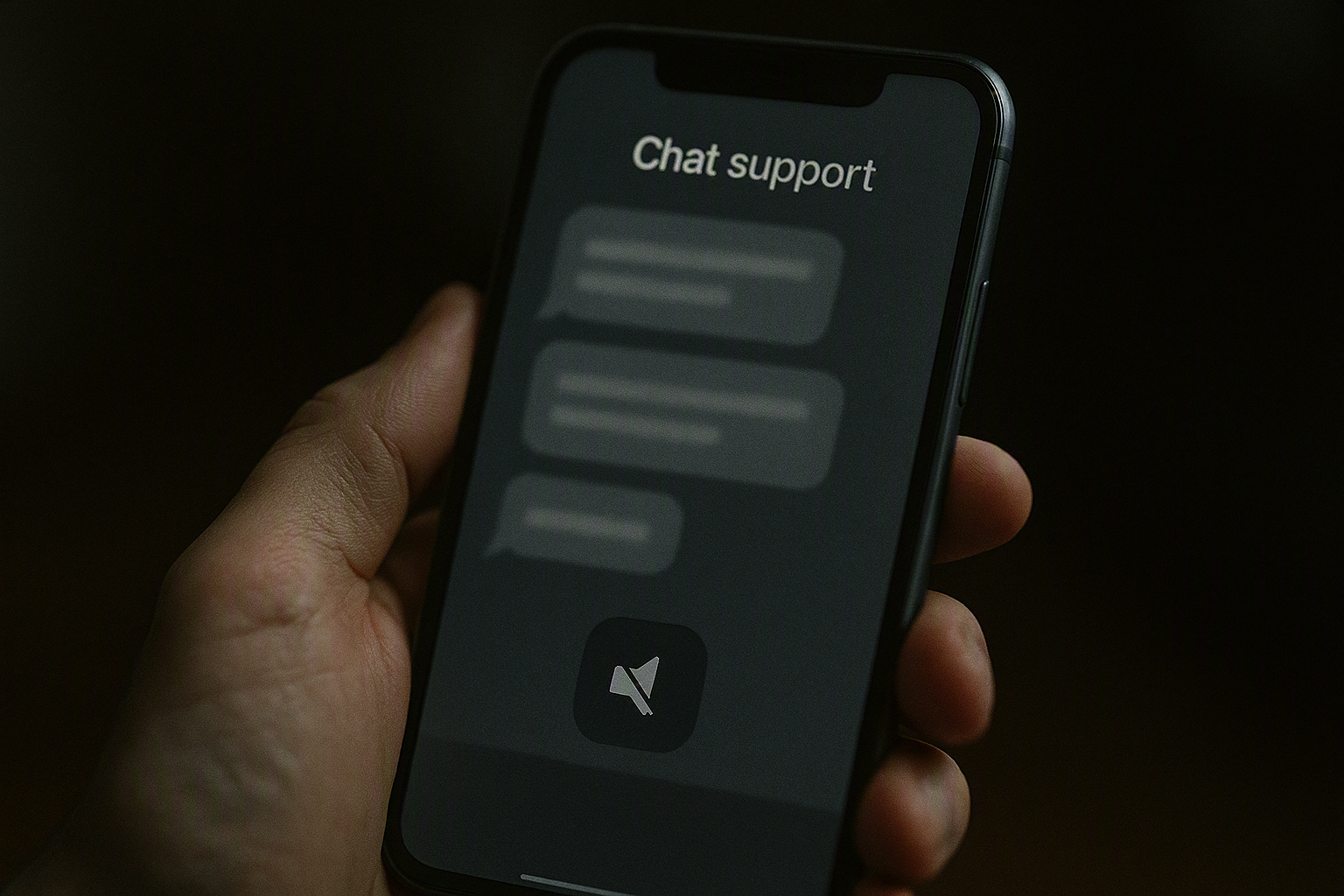
    While I waited, I started my audiobook on the same phone I was using for the chat. Every time a message came in from the agent, a notification sound interrupted the audio.

    I noticed a mute icon at the top of the chat. I tapped it. The icon changed to show it was muted. I restarted the audiobook.

    The next message came in. The sound played. The audiobook stopped.

    The mute button didn’t mute anything. It changed its icon. Those are not the same thing.

    This is a product problem. A design problem. Someone built a feature, shipped it, and either never tested it in a real use scenario or tested it and accepted the gap between what it looked like and what it did. A customer using a phone to listen to something while they wait on a chat is not an edge case. That’s Tuesday.

    These are the kinds of things you find when you walk through your own product as a customer. Not in a lab. Not with a test account. As a customer, with a real problem, in a real context, trying to get something done.


    An Hour Later

    After about an hour of troubleshooting, the agent, who was genuinely helpful and clearly trying, told me there was a process that needed to run on the back end. They’d put in a ticket. It would be resolved, but not tonight.

    Which meant I’d be without a phone until it was.

    I asked what I should do if there was an emergency. They offered a workaround: set up a new line, activate the phone on that, switch back later. Creative. But if the activation experience was this complicated, kicking it down the road felt like borrowing trouble. I declined and started wrapping up the chat.

    Then the agent, almost certainly prompted by their system, offered to tell me about current internet plan upgrades.

    I want to be precise about what happened there. My problem wasn’t solved. I was going to be without a phone overnight. The chat had taken an hour. And the system fired an upsell.

    That’s not a bug. Someone designed that. Someone looked at the data on upsell conversion and decided the trigger should fire regardless of whether the customer’s issue was resolved. The metric the team is measured on includes upsell attempts. So the system attempts the upsell. The customer experience is not the metric.


    What AI Has to Do With Any of This

    None of these problems are AI problems. The session timeout, the mute button, the upsell timing — none of them require a language model to fix. They require someone to walk through the product as a customer, identify what’s broken, and have the organizational support to fix it.

    Six years ago, when I worked there, we were calling out problems like these. Some got fixed. Some didn’t. The ones that didn’t weren’t technically hard. They were prioritization decisions. There was always something more exciting to work on, something more fundable, something that showed better in a demo. Now that something is AI.

    I work in AI. I know what the technology can do and I believe in it. But companies are investing heavily in making their customer service smarter while the foundational product and design problems that have existed for years go unfixed. The AI layer gets better. The experience layer stays broken. The customer lives in the experience layer.

    Here’s the question worth asking before the next AI investment: if you asked your customers what frustrated them most about your product, would any of them say it doesn’t have enough AI?

    Probably not.

    They’d say the mute button doesn’t work. They’d say they had to type every two minutes to keep the session alive. They’d say someone tried to sell them an internet upgrade after failing to activate their phone.

    Those are fixable. They were fixable six years ago. They’re still broken.

    Not because the technology doesn’t exist to fix them. Because the attention is somewhere else.


    I’m still thinking about the mute button.

  • Show Me the Incentive

    Show Me the Incentive

    AI investment priorities reveal more about what we value than any mission statement. Here’s what the numbers are actually saying.

    I was sitting in the gym at my son’s school on career day, watching kids rotate through tables staffed by a dog groomer, a police detective, a state park maintenance worker, and me. My topic was AI.

    I’d played them a song my son made using AI tools. I’d watched their faces when the music came out of a prompt. I’d thought about what these tools could mean for kids like the ones in that room — kids with different abilities, different challenges, different relationships with the systems that were supposed to serve them. The technology felt genuinely hopeful in that moment.

    Then I drove home and opened my inbox.

    I work in AI. I’ve spent more than a decade in this space. I believe in what the technology can do — I’ve seen it do things that matter. But I also watch the money, and the money is telling a different story than the hope.

    In 2026, four hyperscalers committed to a combined $700 billion in capital expenditure, nearly double what they spent the year before. That same year, federal funding for health and science research took cuts that one analysis described as a screeching, and possibly irreversible, halt for many projects. The Gates Foundation, Novo Nordisk Foundation, and Wellcome jointly committed $60 million to evaluate AI health tools in low- and middle-income countries. Sixty million dollars. Against $700 billion.

    That ratio is not an accident. It’s an incentive structure.

    Charlie Munger said it plainly: “Show me the incentive, and I’ll show you the outcome.” The incentive right now is return. The outcome is what we’re seeing — infrastructure investment at a historic scale, enterprise deployments producing almost no measurable ROI, and the applications that could matter most to the most people starved of the capital that’s going elsewhere.


    The Market Is Working Fine

    That’s the uncomfortable part. This isn’t a story about a broken system. The market is functioning exactly as designed. Capital flows to the highest expected return. Consumer AI applications have enormous addressable markets. Infrastructure that powers those applications generates reliable revenue. Health AI for rare neurological conditions has a small addressable market and a long development timeline. The math isn’t hard.

    Upton Sinclair put the human version of it this way: “It is difficult to get a man to understand something when his salary depends on his not understanding it.” The people making investment decisions aren’t ignoring the potential of medical AI out of malice. They’re ignoring it because the incentive structure doesn’t reward understanding it. Not yet. Maybe not until it’s too late to matter.

    My son has epilepsy. I think about what AI-driven research could mean for conditions like his — better seizure prediction, smarter medication titration, earlier intervention. I think about it the way any parent thinks about something that could help their kid. And I know better than to frame it as epilepsy versus cancer, because that’s a trap. The question isn’t which disease deserves the investment. The question is why we’ve built a system that forces us to choose between them at all, while $700 billion goes elsewhere.

    The answer is incentive. And right now, the incentive doesn’t point there.


    Progress and Profit Are Not the Same Thing

    Companies should make money. Profit funds research, attracts talent, builds the infrastructure that eventually enables the things that matter. The hyperscaler investments aren’t going nowhere — they’re building the compute layer that researchers will use for decades. AlphaFold happened because the underlying models and infrastructure existed. I know this. And the productivity gains from AI deployment are real. The capability improvements are real. Some of what’s being built right now will matter enormously.

    But profit and progress are not the same thing, and we keep talking as if they are. We tell the story of AI as the technology that will solve our biggest problems — climate, disease, inequality — while the actual investment pattern optimizes for something else. That gap between the story we tell and the system we’ve built is worth naming.

    The tendency to optimize for what’s measurable and near-term at the expense of what’s important and long-term is not something AI introduced. We’ve been here before. But the scale of this wave, its speed, and the environmental cost of the compute it requires compound the stakes in ways that previous cycles didn’t.

    The bubble will eventually correct. It always does. Ninety-five percent of enterprise AI pilots are producing no measurable return. The capital is burning, and the patience of the people funding it has a limit. When the correction comes, the investment will contract, the priorities will shift, and whatever window existed to point this technology at the hard problems will have narrowed.

    The people most likely to benefit from AI-driven medical research are not the people funding the infrastructure. The people absorbing the cost of the job displacement are not the people who will capture the upside when the next wave arrives. That asymmetry isn’t new. It’s the pattern every technology wave produces.


    What I Do Know

    The bubble will correct before the incentives do.

    That’s the pattern. And when it does, the window on the things that actually mattered will have narrowed — maybe irreversibly for some of them. Climate doesn’t wait for market corrections. Disease outbreaks don’t pause while capital regroups. Federal research budgets, once cut, don’t come back on the same timeline they left.

    The market won’t fix this on its own. It doesn’t have to — that’s not what markets are for. Regulation could change the incentives. Public funding could change them. Coordinated pressure from the organizations deploying AI could change them if those organizations decided that the story they’re telling about AI’s potential was one they wanted to be accountable for.

    None of that is happening at the speed the problem requires.

    Show me the incentive. The outcome is right there.


    What I’m Left With

    I drove home from career day thinking about those kids. About what the technology could mean for them if it pointed in their direction. About my son and what a different investment pattern might make possible for people like him.

    I still believe in the technology. I believe in what it can do when it’s pointed at the right problems. I’ve seen it.

    I just think we should be honest about where it’s pointed right now. And curious enough to ask whether that has to be true.

    Why are we doing it this way? Does it have to be this way? What would it look like to do it differently?

    Those aren’t rhetorical questions. They’re the ones worth sitting with.

  • The Same Rocket, A Different Ship

    The Same Rocket, A Different Ship

    AI investment is accelerating faster than any technology wave before it. The pattern underneath it is older than most of us realize.

    There is something deeply human about looking up.

    We’ve always done it. We looked at the stars and decided we belonged there. We looked at the horizon and built ships to cross it. We looked at problems that seemed impossible and found ways to make them less so. That instinct, the refusal to accept limits as permanent, is responsible for most of what we’ve built.

    It’s also responsible for a pattern that keeps repeating. And we never seem to learn it.

    Every generation gets a technology that feels like the one. The thing that will finally close the gap between what we can do and what we’ve always wanted to do. Computers. Then software. Then the internet. Then big data. Each one arrived with genuine capability and genuine promise. Each one attracted enormous investment. Each one produced real gains, new industries, new efficiencies, new possibilities that didn’t exist before. And each one, eventually, ran into the distance between what the demo promised and what the real world required.

    That gap never closed the way we expected. So we did what we always do.

    We threw more fuel at it.

    (more…)
  • The Leveler: The Use Cases Nobody Planned For

    The Leveler: The Use Cases Nobody Planned For

    I sat at a table in the gym at my son’s school. Around the room there was a dog groomer, a police detective, someone from the state park maintenance crew, and an archaeologist. We were there for career day. My topic was AI.

    When each group of kids came over, I played them a song. I told them my son made it. He had the idea, shaped the lyrics, and used AI tools to bring it to life. It’s on Spotify and Apple Music. The instruments, the vocals, the production were all generated by AI. But the idea, the story, the words were his.

    Some of the middle school kids had already used ChatGPT. A few had used it for homework. One wanted a training plan for a video game he was trying to get better at. One girl said she used it as someone to talk to.

    That last one stopped me. The adults in the room were thinking about AI in terms of what it might take from these kids. That girl was using it for something none of the adults had thought to offer her.

    (more…)
  • Defining Success Criteria: Do You Know Where You Are Going?

    Defining Success Criteria: Do You Know Where You Are Going?

    It was the tenth call.

    I had been on the first one. A customer data project, matching records across systems to connect outcomes to the right source. It seemed straightforward enough that I handed it off and moved on. What followed was eight more calls between my team and the customer, each one ending with a tweak to the logic, each tweak fixing something and revealing something else.

    The problem wasn’t the code. It wasn’t the team. It was that nobody had defined success criteria before the work started. Nobody had asked: what does done actually look like?

    By the time my team pulled me back in, it was already swirling. The customer’s manager had joined too. I suspect that because the issue still wasn’t resolved, he felt the need to get involved. We had a piece of logic built by people who were no longer on the team, results that were almost always right, and a team that had been grinding on this for weeks.

    I asked a simple question: What do you actually want?

    That was it. Every previous conversation had been about what the code wasn’t doing right, assuming the approach was sound and just needed adjustment. Nobody had stopped to ask whether the approach itself was the right one. The answer to that simpler question was: when this happens, here is what we expect to see. And the solution that followed was far simpler than what we had been building toward. A defined set of conditions, clearly mapped to outcomes. The complexity we had been wrestling with wasn’t a feature of the problem. It was a feature of never having properly defined the problem.

    We left that meeting with a clear destination. We should have had that conversation on call one.

    (more…)
  • The Code Nobody Understands: The Hidden Risk of AI-Generated Code

    The Code Nobody Understands: The Hidden Risk of AI-Generated Code

    The error message appeared at 2:17 a.m. Something about a null reference in a service that hadn’t been touched in weeks. The developer on call pulled up the relevant file, read through it, and felt a familiar but newly uncomfortable sensation.

    She had written this code. Her name was in the commit history. But she hadn’t really written it. She’d accepted it. Reviewed it in the way you review something when you’re moving fast, and the output looks right, and the tests pass. The AI had generated the logic. She had approved the shape of it. And now, at 2:17 a.m., she needed to understand not just what it did but why it did it that way: what assumption it was built on, what edge case it was avoiding, what the author had been thinking.

    There was no author. Not in the sense that mattered.

    (more…)
  • Enterprise AI Implementation: You Were Promised Everything. Here’s What It Took.

    Enterprise AI Implementation: You Were Promised Everything. Here’s What It Took.

    It was, by all appearances, a standard enterprise AI implementation.

    The summaries looked clean.

    At the top of the screen was a concise paragraph capturing a customer interaction: what was requested, what was explained, and what follow-up was required. Action items were listed neatly below. It was the kind of output you could screenshot for a slide deck. Efficient. Polished. Convincing.

    The premise was simple. If employees spent less time documenting interactions, they could spend more time serving customers. Efficiency would increase. Costs would decrease. The model worked in the demo. It summarized transcripts fluently and quickly. The business case felt straightforward.

    It moved forward.

    The strain didn’t appear in the demo. It appeared in real use.

    (more…)
  • The Other Hand: AI, Disability, and the Cost of Progress

    The Other Hand: AI, Disability, and the Cost of Progress

    I’ve spent more than a decade working in AI. I’ve built teams around it, led products powered by it, and spent more hours than I can count thinking about where it creates value and where it doesn’t. I’m not a skeptic. I’ve seen what the technology can do when it’s applied well.

    I’m also the father of a son with epilepsy. He is sixteen, and he will probably never drive. Autonomous vehicles have been part of how I think about his future for a while now — not as a certainty, just as a possibility worth holding onto. So when I came across a Freakonomics podcast about what a driverless world might mean for people who can’t drive, I expected something that confirmed what I’d been quietly hoping. Instead it pulled in two directions at once.

    That tension is what this post is about.

    (more…)
  • The Workbench: A Fictional Exploration of AI, Patents, and Asymmetric Trust

    The Workbench: A Fictional Exploration of AI, Patents, and Asymmetric Trust

    A short work of speculative fiction about mediated cognition and structural asymmetry in AI systems.

    I’ve worked on the same problem for three years. Agricultural runoff — specifically, a low-infrastructure filtration approach practical for small farms that can’t justify the capital cost of existing solutions. I have notebooks. I have a corner of my basement with a workbench and a lamp. I work at night because that’s when the house is quiet, and no one needs anything from me.

    I’m not describing this to be romantic about it. I’m describing it because the habit matters to what happened.

    (more…)
  • When AI Safety Commitments Become Ballast

    When AI Safety Commitments Become Ballast

    There’s a moment in every race when weight starts to matter.

    At the beginning, you carry everything. Redundancy. Margin. Contingency. The assumption is that you can afford to be careful, that prudence is a strength rather than a liability.

    Then someone pulls ahead.

    (more…)