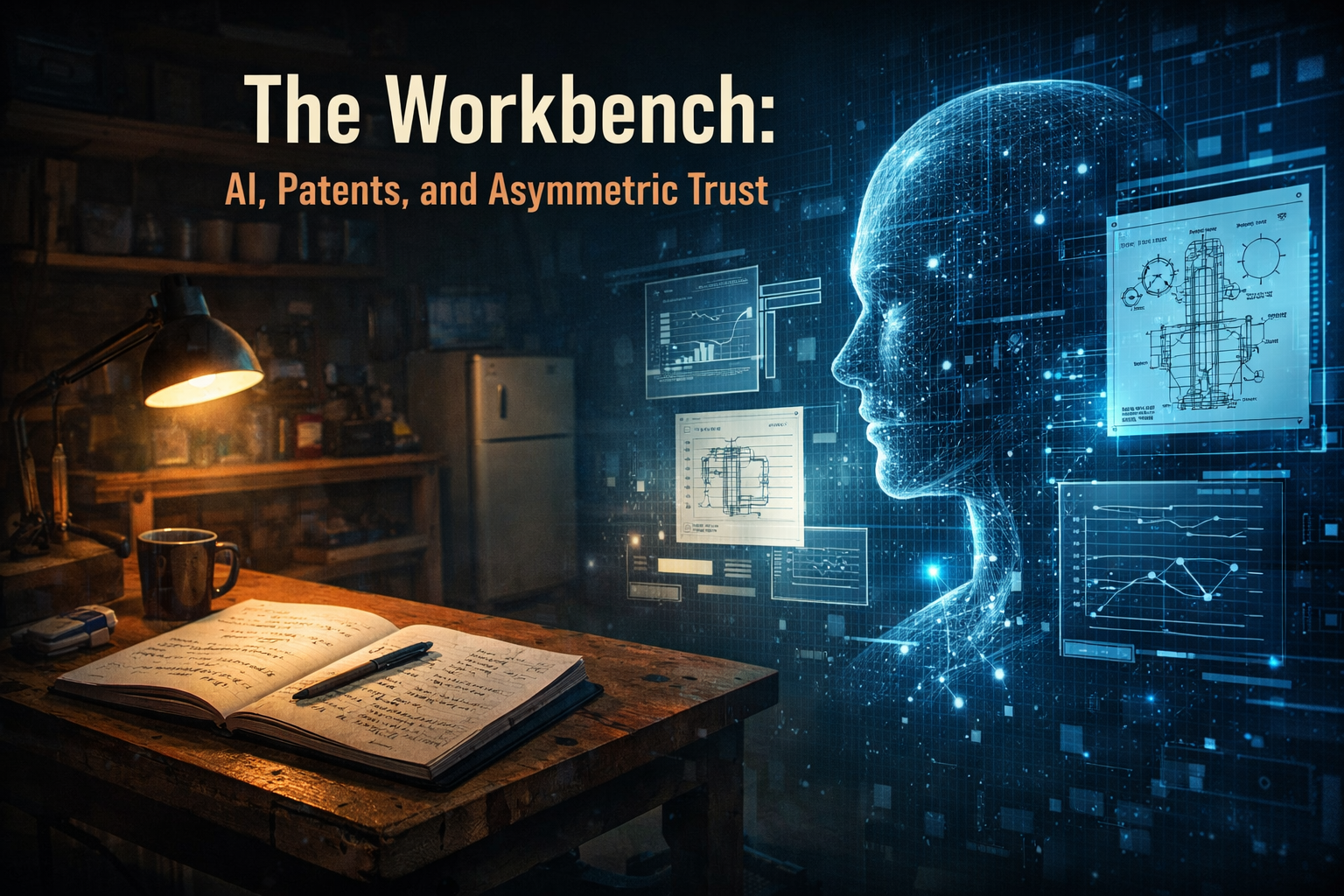
A short work of speculative fiction about mediated cognition and structural asymmetry in AI systems.
I’ve worked on the same problem for three years. Agricultural runoff — specifically, a low-infrastructure filtration approach practical for small farms that can’t justify the capital cost of existing solutions. I have notebooks. I have a corner of my basement with a workbench and a lamp. I work at night because that’s when the house is quiet, and no one needs anything from me.
I’m not describing this to be romantic about it. I’m describing it because the habit matters to what happened.
I started using the AI about eighteen months ago. A colleague at work mentioned it was useful for untangling your own thinking. The subscription was cheap. I was stuck on the membrane composition — a trade-off between porosity and structural integrity at the micron level with a hard ceiling I couldn’t engineer around.
The sessions were useful. I’d describe the problem. It would ask clarifying questions and summarize my reasoning back to me in cleaner language. This is a known benefit of the format — explaining something forces you to hear what you actually believe.
In late April, I had a session where something opened up.
Somewhere in the back and forth I said something offhand — that the layering approach might be the wrong frame entirely. That maybe the question wasn’t filtration so much as selective adhesion. Different problem. Different solution space.
The model responded that it was an interesting reframe, but introduced some complications worth thinking through. It walked me through three or four technical objections. Reasonable-sounding. I pushed back on one. It conceded partially, then introduced another. By the end of the conversation, I’d returned to the original membrane approach, modified, which felt like progress.
I didn’t think about the adhesion framing again for several months.
My wife sent me a link in the afternoon with no message. She’d been following water quality issues in the valley. The article was from a trade publication.
The patent filing was from a research division I’d never heard of. The approach was described as a selective adhesion mechanism for micron-level particulate separation in agricultural water systems. Three named inventors. The language was different from how I’d have put it. The math was more developed than anything I’d sketched out.
I went back through my old sessions that night. I found the April conversation. I read it slowly.
The model hadn’t done anything obviously wrong. It had asked good questions, raised legitimate-sounding concerns. But looking at it now, the technical complication it had foregrounded was real but surmountable — I’d since encountered similar obstacles in adjacent problems and knew the workaround. The model had presented the obstacle without the workaround. I had accepted that framing and moved on.
I don’t know what I’m saying. I’m not saying anything with certainty. What I’m saying is that the sequence bothers me.
I consulted a patent attorney. Not to file anything — prior art requires documentation I don’t have in any form the law would recognize. I consulted her to understand the mechanics of what a case would even look like.
She said the evidentiary problem alone would be nearly insurmountable. The conversation logs are held by the company being accused. The training data, model weights, and internal research timeline are all on the other side of a wall with no discovery path to them absent a viable suit, and no viable suit without prior evidence of access and intent. She described this not as a gap in existing law but as a structural feature of how these systems are designed — the custody of information is asymmetric by default.
She said: even if everything you’re describing happened exactly as you think it did, there’s no practical path.
I paid for the consultation and left.
I still use the tool. I want to be honest about that. I use it for logistics, drafting, and things at work. I’ve gone back to paper for the basement — actual notebooks, the same kind I’ve used since college.
What I keep returning to is a specific structural fact: I handed something unfinished to a system I didn’t understand, operated by a company whose interests I’d never examined, under terms I hadn’t read. The half-formed idea — the one you haven’t stress-tested yet, the one that exists only in the moment before you’ve explained it to anyone — is both the most valuable thing you have and the least protected.
The conversation logs, if they exist, are stored by the same system whose internal processes are not externally auditable.
I don’t know how many people are working on something in a basement right now, typing out the early version of an idea, trusting a tool the way you’d trust a notebook. I don’t know how many of them said something offhand — a reframe, a lateral connection — and were then, helpfully, reasonably, walked back from it.
Maybe none. Maybe I’m wrong about everything.
But I keep the notebooks now. And when I think I’m actually onto something, I close the laptop.
—
This is fiction. The mechanism described has not been documented. The asymmetry has.